Key Points
"Big Short" investor Steve Eisman said he doesn’t see today’s AI boom posing the same risks as the lead-up to the global financial crisis.
Eisman said a possible downturn in AI would be like a major automaker going out of business -- but not a financial crisis.
Long-term investors should consider S&P 500 ETFs if they’re worried about tech stocks.
Steve Eisman, whose character was played by Steve Carell in the movie "The Big Short," recently appeared on The Compound and Friends podcast. Many people look to Eisman's analysis to evaluate risks facing the market. He got famous as one of the investors who predicted the 2008 housing market crash. But Eisman doesn't think we're on the verge of a comparable crisis.
In recent months, some investors have grown nervous about artificial intelligence (AI) stocks. They question whether AI is going to pay off for investors, or if major tech companies are spending too much (and taking on too much debt) to build data centers and develop expensive AI models. Could this be the start of another dot-com crash, or another financial crisis?
Missed Nvidia in 2009? This Rare Signal Is Flashing Again.In 2009, a "Double Down" signal flashed for a little-known chipmaker called Nvidia. For the first time in years, that same "Total Conviction" signal is flashing for a company 1/100th the size of Nvidia. Continue »
On the podcast, Eisman said, "If you want to draw parallels to the great financial crisis, there's a big difference" with what's going on now in AI stocks.
Let's look at what Eisman thinks about today's AI stock market boom and why long-term investors don't need to panic -- even if they feel more cautious about the tech sector.
Image source: Getty Images.
Why the 2008 stock market crash was so bad
Here's the thing a lot of younger investors who weren't involved in the stock market during 2008 might not know: That was an exceptionally terrible stock market crash, probably the worst economic crisis of my lifetime. Here's what happened to the S&P 500 index (SNPINDEX: ^GSPC) in 2008:
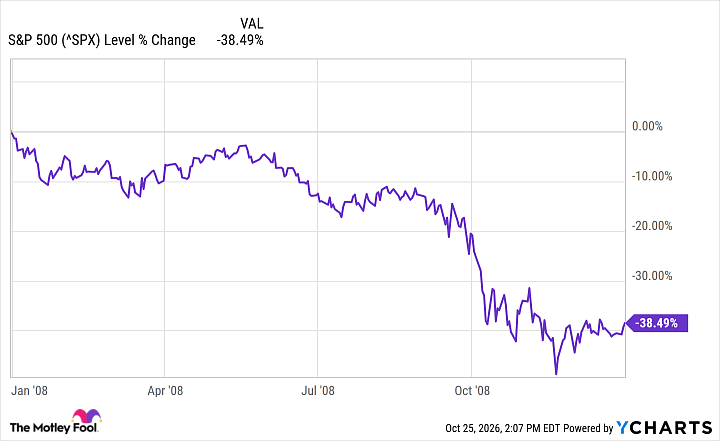
Why was 2008 so bad? Major investment banks, like Bear Stearns and Lehman Brothers, failed. Investors suddenly realized that too much of the economy had been propped up by bad mortgage debt. Too many homeowners suddenly couldn't afford to pay their debts after interest rates rose. Too many big banks made big bets on the housing market, with the idea that the industry was just going to keep growing. These big bets ultimately went bust.
When people lose trust in the financial system, the entire economy can collapse. That doesn't seem to be the case with the AI boom.
Eisman: AI is more like General Motors than JPMorgan
In his podcast interview, Eisman explained how there are a few different levels and sizes of economic crises that can cause recessions. He gave this hypothetical example: What if a major employer like General Motors goes bankrupt?
If a big company like General Motors goes out of business, it causes a lot of pain. People lose their jobs. There might be a local or regional recession within the economies of the cities and states where that company has a lot of employees and suppliers.
But even though a bankruptcy of that size would be bad for the economy, it still would be nowhere near as bad as 2008. In 2008, major banks failed or were on the verge of failure. The government had to bail out the banks to prevent the financial system from collapsing. This was much worse than GM going out of business; this could have become a new Great Depression -- or worse.
On the podcast, Eisman gave another hypothetical example of a globally systemically important bank like JPMorgan Chase going bankrupt. As Eisman said, if a big company like GM goes down, it's bad. But he also said:
When JPMorgan goes down, planet Earth burns. That's the end. The reason the government had to bail everybody out was you can't have a situation where people can't get their money out of the bank.
Eisman said the possible AI bubble is more like the General Motors example. Even if the AI boom turns out to be disappointing, even if it goes bust and the stock market crashes, Eisman doesn't believe this would be as bad as 2008 because as he said, "The banks are fine."
How to invest for an AI stock crash
It's possible that the recent AI-related boom in the stock market will keep going for a while longer. The biggest tech companies on Earth are trying to build the must-have business tools and consumer apps of the future. If AI pays off, the rewards for investors could be life-changing.
If you believe that the future of AI is bright and that we're still in the early days of the AI revolution, if you believe that the biggest winners from the future of AI will be the tech companies that are building AI and aggressively adopting AI tools today, buying tech ETFs could be a good move. The Invesco Nasdaq QQQ ETF(NASDAQ: QQQM) lets you own the entire tech-heavy Nasdaq-100 for a low expense ratio of 0.15%.
But if you're worried that AI is a little overhyped and overpriced, if you feel like other parts of the economy might do better in the future than just a few tech majors, you might want to invest in a broad stock market index fund like the Vanguard S&P 500 ETF(NYSEMKT: VOO) with a super low expense ratio of just 0.03%.
A possible AI stock sell-off could still hurt the S&P 500, but the downturn might be less severe than in a tech ETF. In the long run, buying the entire S&P 500 tends to be a solid move -- even if there are a few sell-offs and bear markets along the way.
Missed AI’s "Act 1"? Act 2 Could Be 14x Bigger
Most investors think they missed the AI boat because they didn't buy Nvidia in 2005.
But according to our analysts, we’re only at the end of "Act 1"—the R&D phase. "Act 2" is the global rollout, a massive technology build-out that Google’s CEO says could be more profound than fire or electricity.
While everyone watches the chip designers, one "backbone" company provides the critical technology that Nvidia and AMD literally cannot function without. We’ve detailed this under-the-radar player in our new AI Playbook.
JPMorgan Chase is an advertising partner of Motley Fool Money. Ben Gran has no position in any of the stocks mentioned. The Motley Fool has positions in and recommends JPMorgan Chase and Vanguard S&P 500 ETF. The Motley Fool recommends General Motors. The Motley Fool has a disclosure policy.
